

We are already enrolled in Ohio Medicaid.
Our medical group is an enrolled Ohio Medicaid provider and has closed more than 14,000 care gaps in the last two years. Start us on the work you already need done, then let us turn those same members into a continuous recovery relationship instead of a claim you see again in ninety days.
Scroll to the bottom to reach us directly.
Ohio Medicaid, today
Our medical group is already an enrolled Ohio Medicaid provider. No new entity, no new credentialing cycle, no waiting.
Care gaps closed
Over the last two years, across Medicaid plans. Gap closure is our wheelhouse and it is the fastest place to start.
Members on the platform
The largest peer recovery community in the country, free and anonymous to the member, running every hour of the day.
The gap
Treatment is episodic. Relapse is continuous.
A member leaves a residential program, an emergency department, or a counseling session and returns to the same environment that made them unwell. The system loses sight of them until the next crisis generates the next claim. Nothing is watching the space in between, and that space is where recovery is actually won or lost.
Sober Sidekick and Wakely Consulting Group, an HMA Company
Health plans spend $3.64 on crisis for every $1 on recovery.
We asked Wakely, an HMA company, to classify every SUD dollar across a recovery-value spectrum. They analyzed $569 million in allowed cost across roughly 150,000 lives with a primary substance use diagnosis. The finding is the single most useful number we have for a conversation with a health plan. The book is ACA marketplace rather than Medicaid, so read the ratio as the transferable finding and the dollars as directional.
Every dollar of sustained-recovery spend, against what crisis takes
For every $1 of SUD-primary spend on services that sustain recovery, $3.64 goes to acute stabilization and short-cycle services. Across roughly 150,000 ACA marketplace lives and $569 million in allowed cost, that is not an allocation anyone chose. It is what fragmented continuity of care produces on its own.
Where the dollars actually land
ED, ambulance, detox, short-term residential, partial hospitalization
MAT, case management, psychotherapy, preventive primary care
Source: Wakely ACA Database, 2023 benefit year, primary SUD diagnosis ICD-10-CM F10 to F19. Recovery-value classification developed jointly by Wakely actuaries and HMA substance use subject-matter experts. Mid-value services are excluded from the two percentages shown, so they do not sum to 100.
The glide path
Two rungs, and they compound.
The 3.64 to 1 ratio tells you the money is in the wrong place. The Validation Institute certified outcome tells you what happens when it moves. Those are two different savings arguments, and a plan does not have to accept the second one to act on the first.
per engaged member, per year
The opportunity the joint brief quantifies if a portion of acute-stabilization spend shifts toward services that sustain recovery. This is the rebalancing case, and it does not require a single new clinical outcome to be true.
Wakely Consulting Group, an HMA Company
per engaged member, per year
What the same member is worth once Recovery Care is actually delivering the 48.2% reduction in reported relapse. Rebalancing the spend gets you to rung one. Preventing the relapse gets you to rung two.
CHARM Economics, on the Validation Institute certified outcome
Fewer reported relapses
Certified by the Validation Institute
Among engaged members, independently reviewed rather than self-reported. CHARM Economics applied that certified reduction to a Medicaid population and modeled roughly $4,400 in avoided cost per member per year. A relapse episode is expensive in a very specific and well-documented way, and preventing half of them is where the second rung comes from.
Modeled savings. Validation Institute, 2023 Validation Report, Sober Sidekick App, Validated for Outcomes. CHARM Economics, LLC prevention-to-ROI model. Results vary by population, engagement, and local cost structure.
The app
A community that answers, at any hour, for free
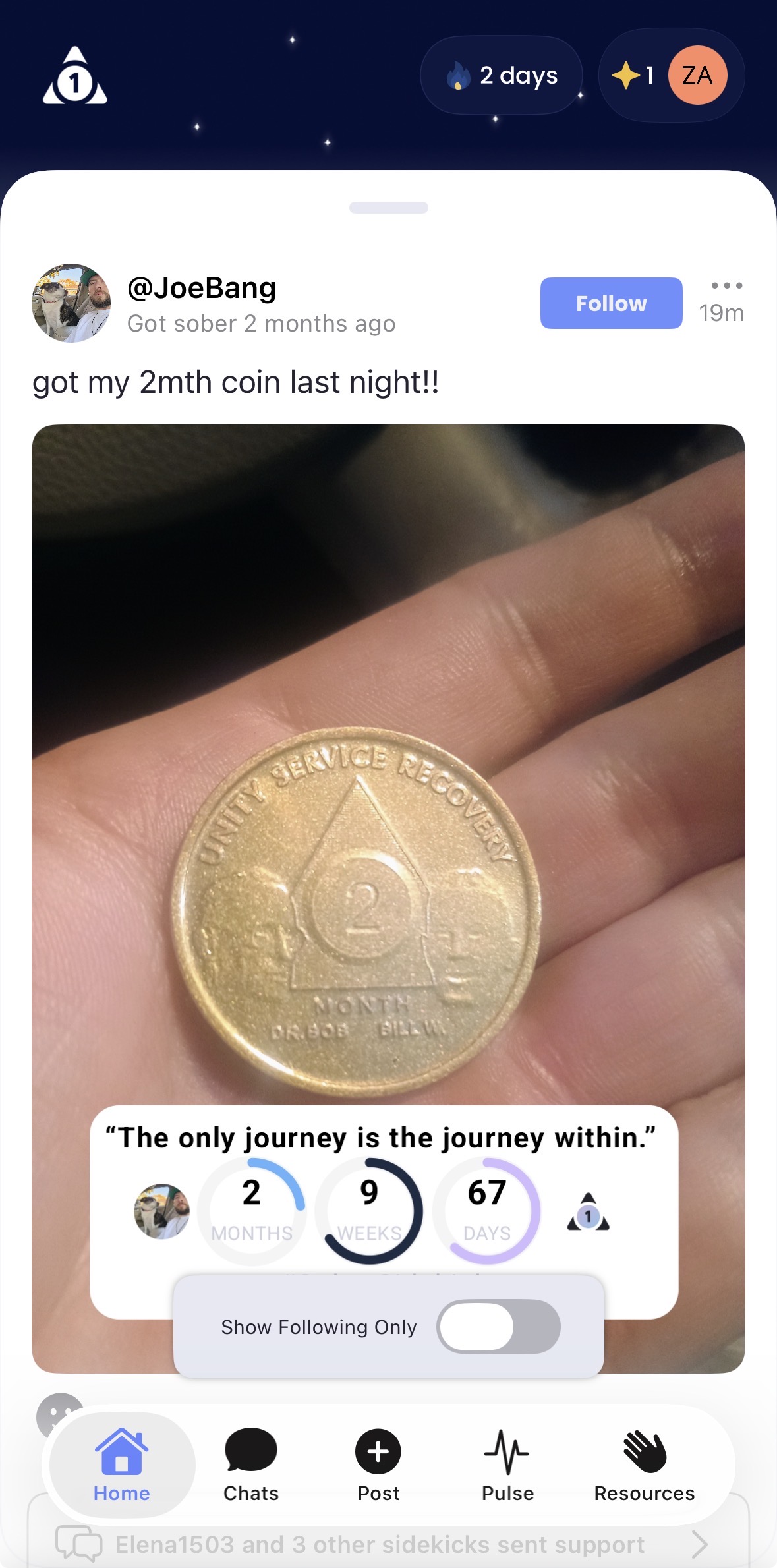
Sober Sidekick is where more than a million people in recovery already are. It is the lowest-barrier entry point in substance use care: no referral, no eligibility check, no cost to the member. Your Ohio members are already on it.
Answered, every time
The Empathy Algorithm makes sure no post goes unanswered. Someone reaching out at 3 a.m. gets a real human reply, not a chatbot and not a waitlist.
Free and anonymous to the member
No insurance card, no intake, no copay, no diagnosis required. The lowest-barrier front door in substance use recovery.
Daily, not episodic
Check-ins, streaks, virtual AA and NA meetings, and a feed that gives people a reason to show up on the days nothing is scheduled.
A signal you can act on
Everything a member does is a data point. Engagement, language, timing, and inactivity roll into a live view of who is drifting toward relapse.
Recovery Care
Relapse reduction counseling, in the palm of their hand
Recovery Care is delivered by our licensed clinical arm: virtual, clinician-led relapse reduction counseling and recovery care planning for members with a substance use diagnosis. The care plan publishes straight into the member’s app, where the peer community keeps them on it between visits.
Practicing the moment before it happens
Thousands of scenarios, each one built by a clinician
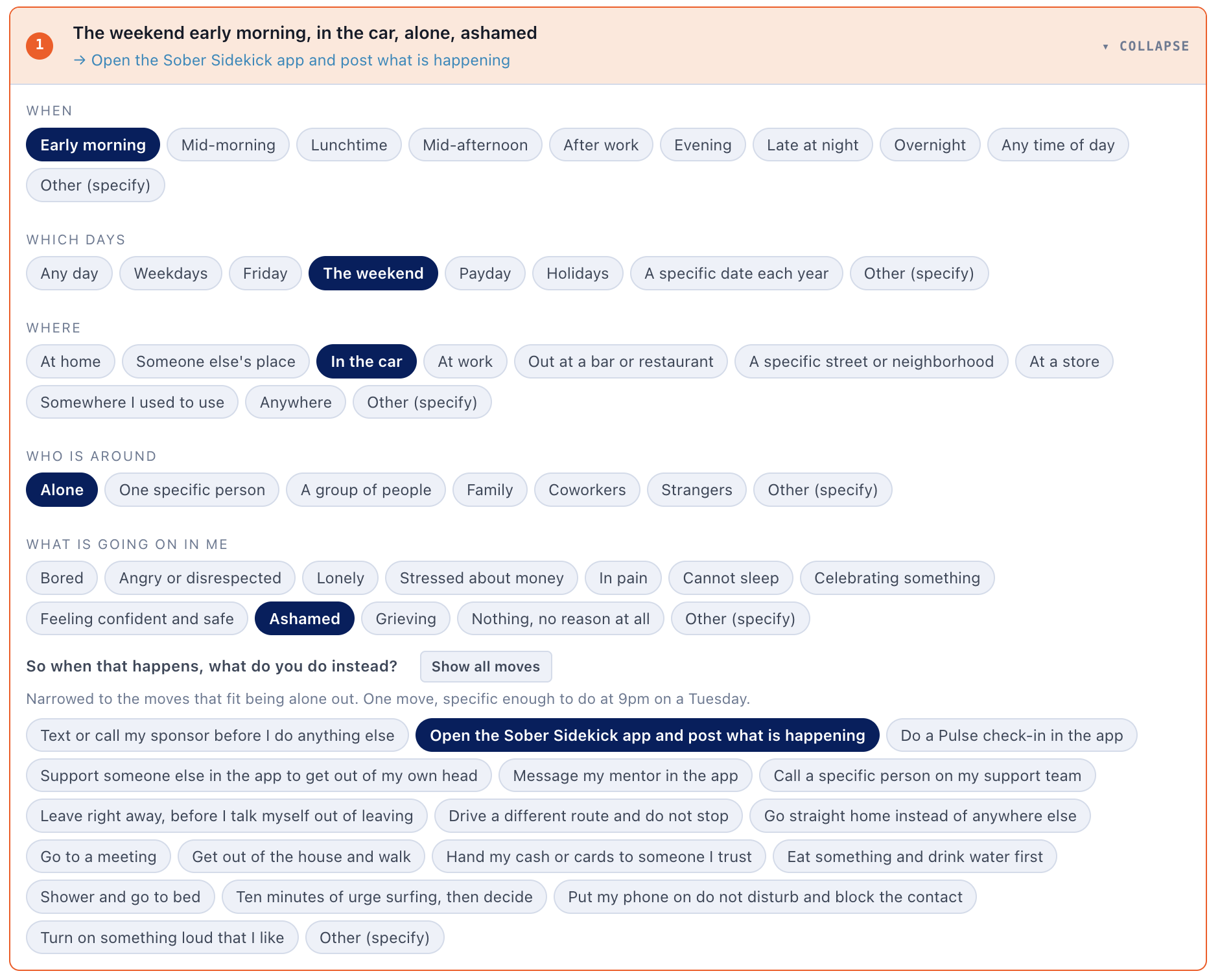
A relapse almost never comes out of nowhere. It comes out of a specific combination: a time of day, a place, who is around, and what is going on inside the person. Our clinicians work with the member to name those combinations before they happen, and to attach one concrete move to each one.
Weekend, early morning, in the car, alone, ashamed. That is a real scenario, and the member already decided what they do instead. By the time it arrives they have practiced it. That is the difference between counseling a member has heard and counseling a member can actually use at 9pm on a Tuesday.
One plan, two screens
The visit cannot close on a half-finished plan
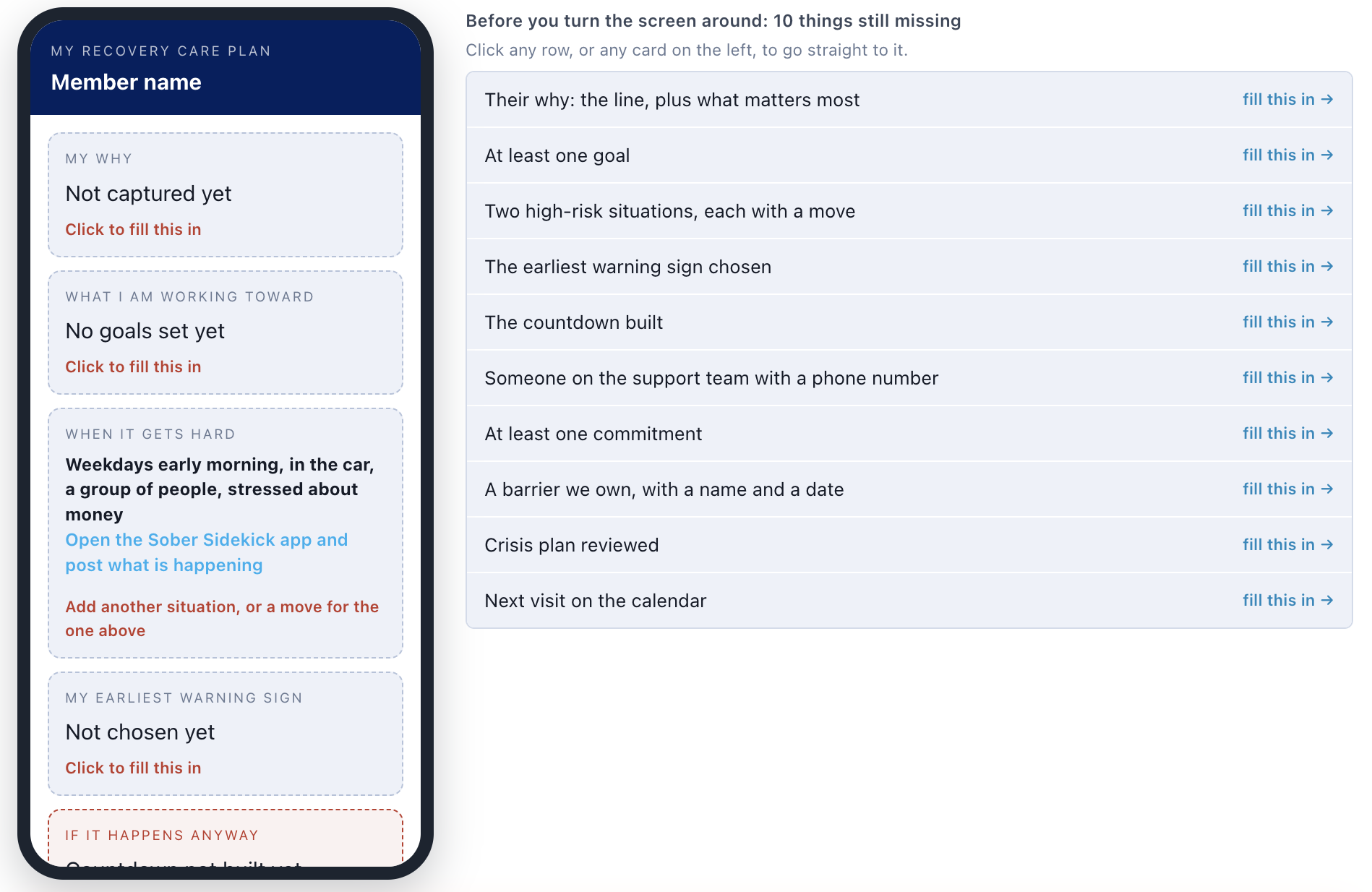
Their why, their goals, their high-risk situations and the move for each one, their earliest warning sign, the person on their support team with a real phone number, and what happens if it goes wrong anyway. The tool tracks every one of those and shows the clinician exactly what is still missing, so an incomplete plan is visible rather than discovered later. The member leaves with the finished version on their phone rather than on a discharge sheet.
Initiation
- Individualized treatment plan built with the member
- Relapse reduction counseling with a licensed clinician
- Recovery care planning and goal setting
- Care coordination and social-needs barrier removal
Ongoing engagement
- Recurring monthly relapse reduction counseling
- A living care plan that updates as the member changes
- Coordination and referral back to local Ohio providers
- Peer community carrying the member between visits
One continuous journey
We pick people up at the low-value moment and walk them up the spectrum.
This is the whole model in one line. The gap closure visit is not the product. It is the introduction. It is how we get a real relationship with a member at the exact moment the system usually loses them, and every step after it moves that member and their spend toward the recovery end of the curve.
The low-value moment
A member shows up in the ED, leaves inpatient, or goes dark on a wellness gap. Today that moment generates a claim and very little else.
We make contact and close the gap
Our enrolled Ohio medical group performs the qualifying visit. The gap closes, the measure moves, and we now have a relationship with a member the system had lost.
Recovery Care begins
Licensed clinicians build an individualized recovery plan and start relapse reduction counseling. The plan publishes straight into the member’s phone.
The community carries them
Between visits, 1.5 million peers hold the member in a daily habit. Engagement patterns feed a live relapse-risk view that routes back to the care team before the next crisis.
Where we start in Ohio
Start us on the work you already need done.
We do not need a new program to be stood up before we are useful. Our medical group is an enrolled Ohio Medicaid provider and gap closure is what we do at volume. Point us at any of these three and we can be in market quickly, on rates and structures that already exist.
7 and 30 day follow-up after discharge
Emergency department and inpatient discharges, reached inside the window that counts. This is the highest-value moment in the whole system and the one most often missed.
Open wellness and preventive gaps
Annual wellness visits and the preventive gaps already sitting on your pursuable list. Work we do today, at volume, for Medicaid plans.
Postpartum and perinatal programs
Postpartum follow-up where substance use risk and care abandonment overlap sharply, and where a visit that actually happens changes the trajectory.
Every path lands in the same clinician-led, peer-supported virtual model, billed under established Medicaid substance use treatment codes. Program structure and rates are configured per plan.
Evidence
Independently reviewed, not self-reported
Relapse reduction
Validation Institute certified
Crisis to recovery spend
Wakely, an HMA company
Avoided cost per engaged member
Per year, CHARM Economics
Recognized by
 Validated for Outcomes
 Lead Investor
 Case Study Subject
 Innovator of the Year
 ROI Validation
Sources: Validation Institute (2023) · CHARM Economics, LLC · Wakely Consulting Group, an HMA Company (2026) · Sober Sidekick platform data. Modeled savings; results vary by population and engagement.
Let’s talk about Ohio.
If you run an Ohio Medicaid plan and you are trying to hold onto members between appointments, close the gaps you are already accountable for, and move substance use dollars out of the crisis column, that is exactly the problem we work on.
Sober Sidekick is a product of Empathy Health Technologies, Inc.